

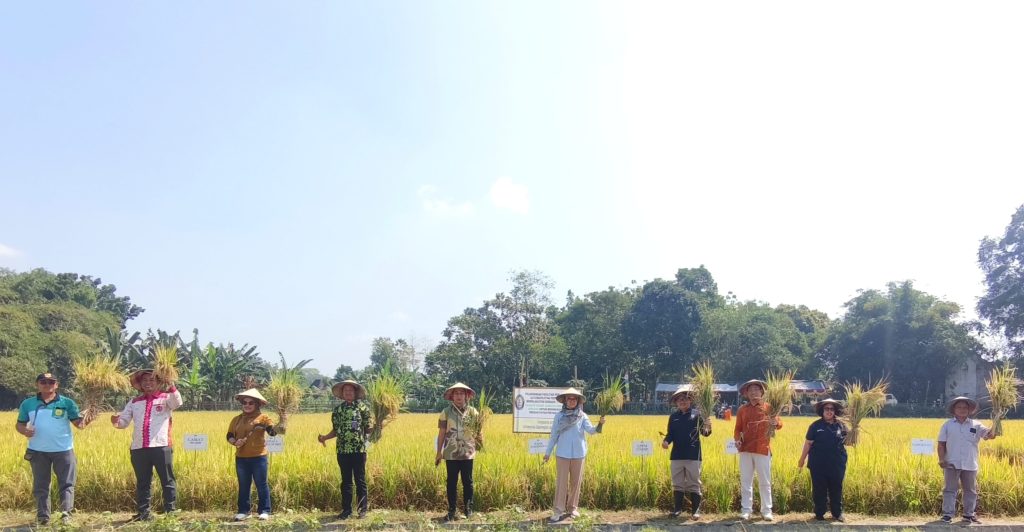
SEMARANG, July 7, 2026 — Bank Indonesia (BI), in collaboration with the Institute for Research and Community Service (LPPM) and the Faculty of Animal Husbandry and Agriculture (FPP) at Diponegoro University (Undip), successfully hosted a Grand Harvest ceremony. Held on Friday, July 3, 2026, at a pilot field in Sobo Village, Geyer District, Grobogan Regency, the event marked the culmination of the “Implementation of Facilitation for the Expansion of Sustainable Agriculture Piloting Based on Climate-Smart Agriculture (CSA) – Biochar Technology” program, an initiative designed to boost rice productivity.
This strategic initiative demonstrates a strong cross-institutional commitment to supporting a transition toward agriculture that is both economically inclusive and adaptive to climate change.
The event was attended by key stakeholders, including: Mega Ramadhanty Chalid, Deputy Director of the Department of Inclusive and Green Economics and Finance, Bank Indonesia. Ditha Aditya Nugraha, Assistant Director of the Bank Indonesia Representative Office for Central Java. Prof. Dr.-Ing. Ir. Suherman, S.T., M.T., Head of LPPM Undip. Prof. Sugiharto, S.Pt., M.Sc., Ph.D., Dean of the Faculty of Animal Husbandry and Agriculture (FPP), Undip.
Local leadership also showed strong support, with representatives from regional and village governments in attendance. Notable figures included the Head of the Food Crops Division of the Grobogan Regency Agriculture Service; Angga Prasetya, Coordinator of the Grobogan Regency Agricultural Extension Workers (PPL); and the Head of Sobo Village.
During her presentation, the Head of the Research Team, Prof. Dr. Ir. Florentina Kusmiyati, M.Sc., explained that implementing CSA technology with biochar interventions provides a research-backed solution to significantly improve the physical, chemical, and biological properties of the soil.
“The use of biochar technology in rice cultivation not only binds carbon in the soil to promote ecosystem sustainability, but it also empirically improves fertilizer efficiency and water retention. Ultimately, this leads to increased crop yields and improved farmer welfare,” stated Prof. Kusmiyati.
Prof. Kusmiyati represented the core research implementation team, which included Undip academics Muhammad Iqbal Fauzan, S.P., M.Sc.; Nani Kitti Sihaloho, M.P.; Albertus Fajar Irawan, S.P., M.Agr., Ph.D.; Anasrullah, S.P., M.S.; Dinda Ayu Sekarnurani, S.P., M.Sc.; and Bagus Herwibawa, S.P., M.Sc., Ph.D.
The event’s highlight was a symbolic harvest ceremony in the rice fields. The harvest was jointly led by representatives from Bank Indonesia’s Central Java Representative Office, the Head of LPPM Undip, the Dean of FPP Undip, the Grobogan Agriculture Office, the Sobo Village Head, the Grobogan PPL Coordinator, the research team leader, and a representative from the local Farmers’ Group Association (Gapoktan).
Following the harvest, attendees observed a live technical demonstration of biochar application in the field. This practical education session was designed to accelerate the transfer of technology from academic researchers to the grassroots level, thereby facilitating seamless adoption by local farmers.
The program was met with great enthusiasm, drawing dozens of farmer groups from various villages across the Grobogan area, including Gapoktan Ngudi Makmur, Subur Makmur, Bancar Tani Makmur, and Sumber Urip. Furthermore, the presence of representatives from PT WasteX and the Bina Tani Sejahtera Foundation underscored the importance of multi-stakeholder partnerships—spanning government, academia, the private sector, and the community—in strengthening sustainable agricultural ecosystems.
Building on the success of this pilot, the collaboration between Bank Indonesia, LPPM Undip, and FPP Undip is expected to serve as a scalable blueprint for climate-smart agriculture. This model aims to support national food security while simultaneously fostering a resilient, green economic ecosystem.